How to Remember Treble and Bass Clef Notes
A short beginner’s guide to the lines and spaces of the staff, with the classic memory phrases and a few practice tips.
Reading music gets much easier once you can name the notes on the staff without stopping to count lines.
Music is written on a staff: five lines and the four spaces between them. A clef at the start tells you which notes the lines and spaces stand for. The two you will meet first are the treble clef (usually the higher notes, such as the right hand on the piano) and the bass clef (usually the lower notes, such as the left hand).
Treble clef
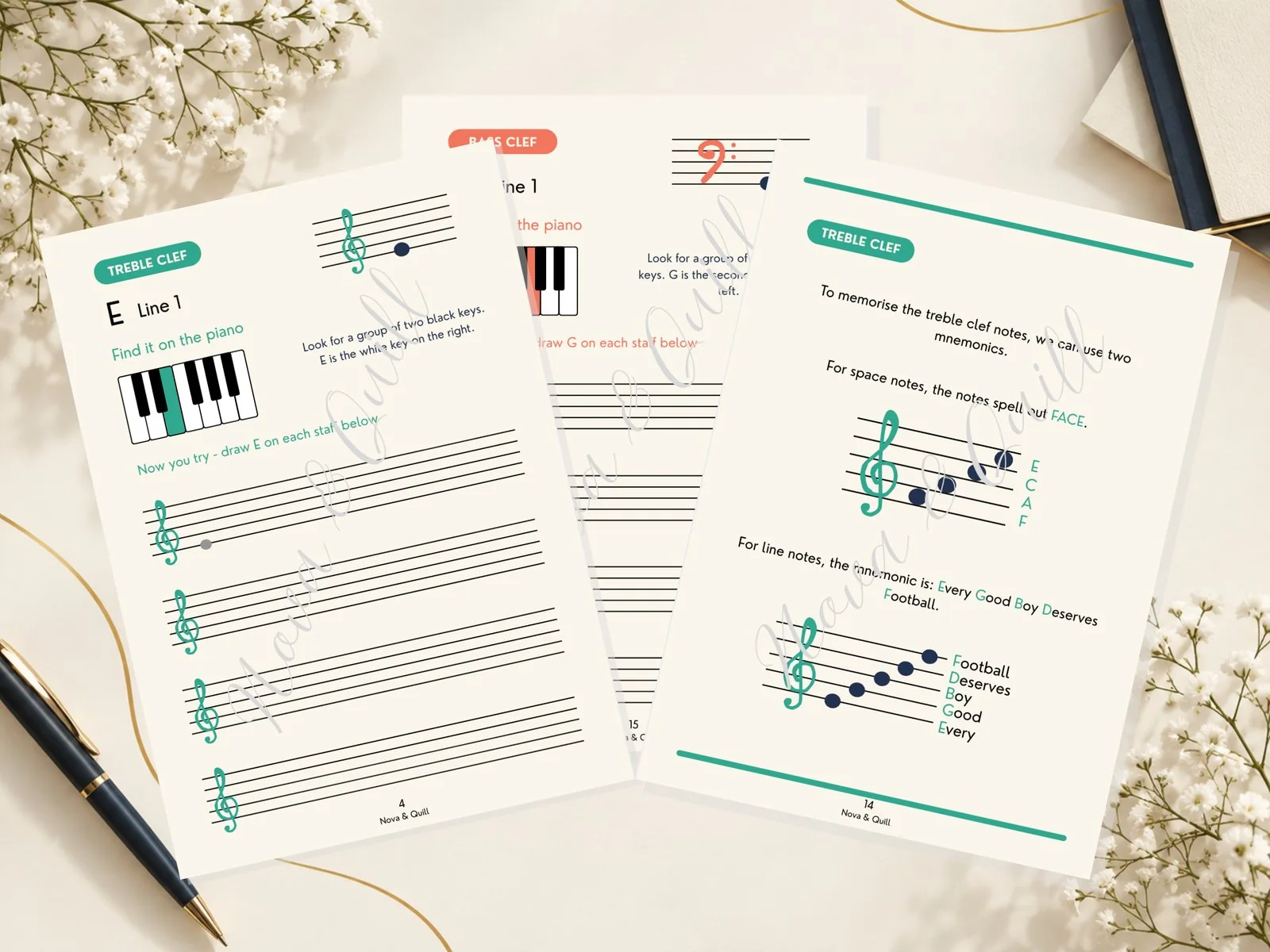
Count the lines and spaces from the bottom up. These phrases are common teaching aids; use any that you find easy to remember.
| Where | Notes, bottom to top | Memory phrase |
|---|---|---|
| Lines | E · G · B · D · F | Every Good Boy Does Fine |
| Spaces | F · A · C · E | Spells FACE |
Bass clef
The pattern is the same, but the notes sit in different places, so the phrases are different too.
| Where | Notes, bottom to top | Memory phrase |
|---|---|---|
| Lines | G · B · D · F · A | Good Boys Do Fine Always |
| Spaces | A · C · E · G | All Cows Eat Grass |
Middle C: the link between the two
Middle C sits between the two staffs, on a short extra line called a ledger line. It is just below the treble staff and just above the bass staff, and it is the note in the middle of the piano keyboard that most people use as a starting point.
Tips for practising
- Start with a few notes. Learn a handful of notes at a time rather than the whole staff at once.
- Use landmark notes. Once you know Middle C, you can work out nearby notes by counting up or down from it.
- Practise a little, often. Short daily sessions work better than one long one.
- Draw the notes yourself. Writing a note on the staff as you say its name helps it stick.
- Try flashcards. Quick-fire note cards are a good way to turn slow counting into instant recognition.
A workbook that goes one note at a time
Our Music Theory Workbook and Flashcards works through the notes in order, treble clef first and then bass clef. Every note has its own page: meet the note, find it on the piano, then practise drawing it. It also includes challenge pages with answers and printable flashcards.